Self-Improving AI Agents Will Define the Next Decade of Artificial Intelligence
The future of AI will not be defined by larger language models, but by autonomous systems that continuously improve themselves. This article explores the emerging research behind self-improving AI agents, adaptive memory, verification, metacognition, and the architectures shaping the next generation
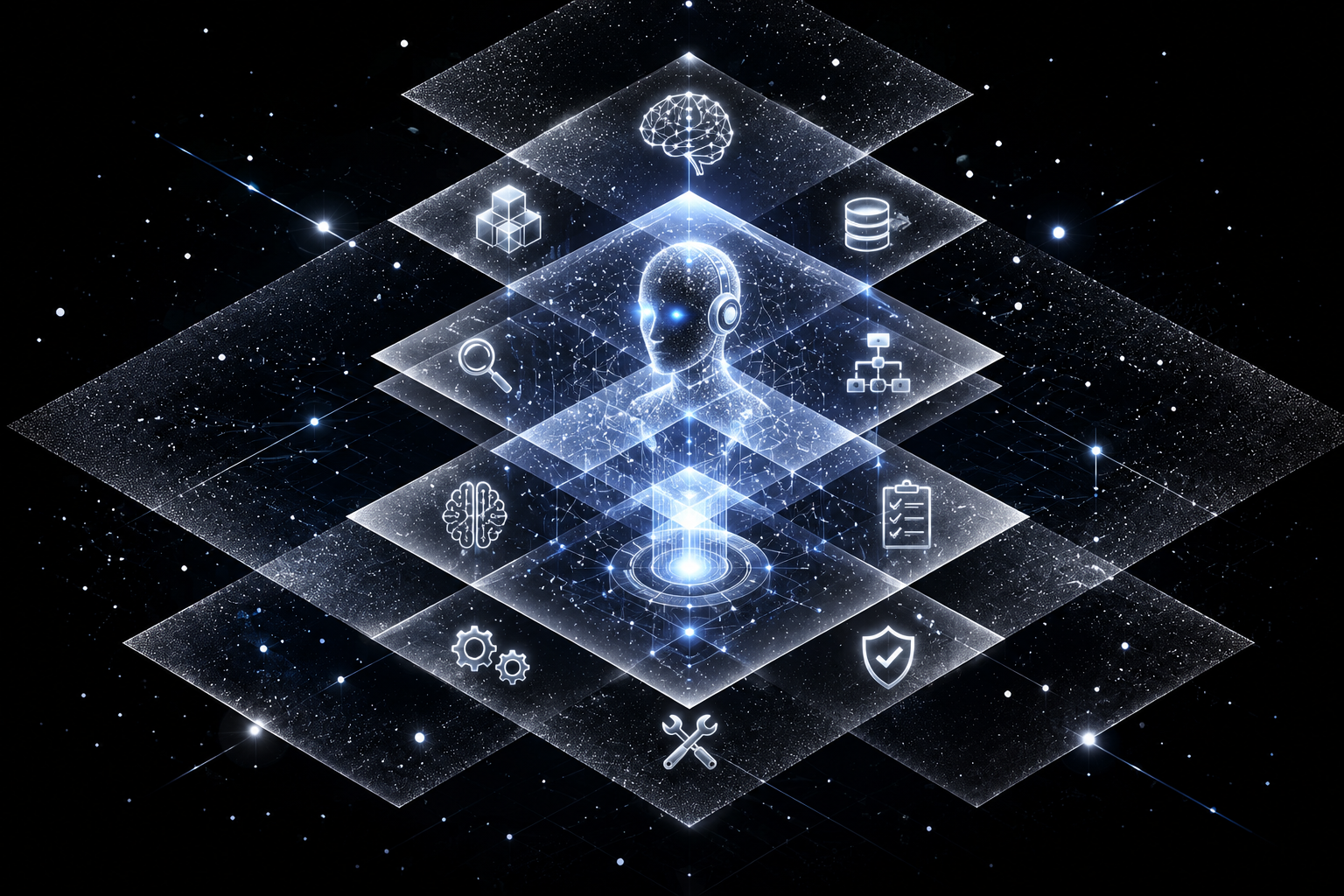
Beyond Prompt Engineering, The Next Decade of AI Agents Will Be Defined by Systems That Improve Themselves
For years, artificial intelligence research focused on building larger models. More parameters, more data, and more compute consistently delivered better performance. That era is rapidly giving way to something far more interesting.
The frontier is no longer just the model.
It is the agent.
Today's most capable AI systems are not simply language models. They are living software systems composed of reasoning engines, memory, planning modules, verification loops, tool use, retrieval systems, orchestration layers, evaluators, and increasingly, mechanisms that allow the entire system to evolve over time.
Looking across dozens of recent research papers from Stanford, DeepMind, Microsoft, Google, NVIDIA, Berkeley, Yale, Oxford, and other leading institutions, one pattern emerges with remarkable consistency.
The future belongs to AI systems that continuously improve themselves.
The Great Shift, From Models to Adaptive Systems
Traditional AI development follows a familiar cycle.
Train a model.
Evaluate it.
Find failures.
Engineers improve the system.
Repeat.
Modern agent research is beginning to remove the human engineer from that loop.
Instead of waiting for developers to redesign prompts, memory structures, planning algorithms, or verification pipelines, agents are beginning to modify themselves based on experience.
This represents one of the largest conceptual shifts in AI since deep learning.
The intelligence is no longer confined to neural network weights.
It increasingly lives inside the architecture surrounding the model.
Intelligence Lives in the Scaffold
One of the strongest themes appearing across current research is that the surrounding infrastructure matters as much as the model itself.
Researchers now describe an agent as consisting of:
Foundation model
Memory systems
Planning modules
Tool interfaces
Prompt structures
Verification pipelines
Routing logic
Long-term state
Control policies
Collectively, this is often called the agent scaffold.
Many recent papers argue that improving the scaffold frequently produces larger gains than changing the underlying language model.
That has profound implications.
Instead of asking,
"Which model should we use?"
we should increasingly ask,
"What architecture allows this model to become better tomorrow than it is today?"
Self-Improvement Is Becoming a First-Class Capability
Perhaps the most exciting direction in current research is self-improving agents.
These systems observe their own failures, diagnose weaknesses, propose modifications, test those modifications, and retain only the improvements that survive evaluation.
Several emerging patterns appear repeatedly:
Failure Mining
Instead of treating failures as isolated mistakes, agents cluster similar failures into recurring patterns.
This creates reusable knowledge rather than one-off fixes.
Harness Evolution
Rather than retraining massive language models, agents evolve the software around them.
They rewrite prompts.
Reconfigure planning.
Improve memory.
Change tool usage.
Optimize orchestration.
The intelligence increasingly lives outside the weights.
Code That Rewrites Code
Some experimental systems now modify portions of their own execution pipeline.
Instead of static architectures, they become adaptive software capable of iterative evolution.
Although still early, this direction resembles biological evolution more than classical software engineering.
Memory Is No Longer Just Retrieval
For years, memory meant vector databases.
That definition is rapidly becoming obsolete.
Recent work reframes memory as an active cognitive process involving:
deciding what deserves storage
organizing knowledge hierarchically
updating incorrect beliefs
forgetting outdated information
auditing stored facts
recovering previous state
learning better retrieval strategies
Several papers even treat memory management itself as a trainable skill rather than a fixed component.
This is an enormous conceptual leap.
Future agents may become better at remembering simply through experience.
Verification Is Emerging as the New Scaling Law
One surprising trend appears across multiple independent research groups.
Performance is increasingly limited not by generation, but by verification.
Modern agents spend growing amounts of computation checking:
correctness
consistency
confidence
factual accuracy
reasoning quality
execution success
safety
Verification is becoming a scaling axis comparable to:
model size
training data
inference compute
Some researchers now argue that future breakthroughs may come more from better evaluators than from larger models.
The Most Important Capability Might Be Metacognition
Humans constantly ask themselves questions like:
Am I correct?
Do I know enough?
Should I continue?
Should I ask for help?
How confident am I?
Most AI systems historically did none of these.
That is changing rapidly.
A growing body of work treats these behaviors as one unified capability:
Metacognition.
Instead of simply generating answers, agents learn to monitor their own reasoning before deciding whether to continue, retry, defer, or seek additional information.
Reliable AI may depend less on producing answers quickly and more on knowing when not to answer at all.
Failure Is Becoming a Timeline, Not an Outcome
Most benchmarks label an agent run as either success or failure.
Recent work argues this misses the most valuable information.
Instead, failures unfold across stages:
The initial mistake.
The point where recovery becomes impossible.
The moment humans finally notice.
This perspective opens entirely new possibilities.
If agents can detect the first stage instead of the third, many failures become recoverable.
Future AI systems may spend more effort preventing irreversible errors than correcting completed failures.
Routing Intelligence Matters More Than Routing Models
As organizations deploy multiple specialized models, routing becomes increasingly important.
However, recent work reveals an uncomfortable truth.
Many routing systems appear effective simply because benchmark accuracy is high, even when routing decisions contribute almost nothing.
Meaningful routing requires two properties:
genuine diversity among available specialists
stable routing decisions under paraphrased inputs
Without both, routing becomes an illusion.
Future systems will likely invest as much in intelligent orchestration as in larger models.
Long-Term Agents Need More Than Memory
Persistent agents introduce challenges absent from single conversations.
They accumulate:
commitments
permissions
credentials
obligations
historical actions
external effects
unfinished tasks
evolving identities
State management is becoming an entire research field.
The next generation of agents will resemble operating systems managing persistent digital lives rather than chatbots answering isolated questions.
The Next Competitive Advantage Will Be Continuous Improvement
Today's software ships with updates every few weeks.
Future AI agents may update themselves continuously.
Not by changing their foundation model.
By improving:
memory structures
planning strategies
tool selection
verification methods
routing logic
decomposition strategies
execution policies
evaluation criteria
The best agent six months from now may not simply start smarter.
It may have learned thousands of improvements through autonomous experience.
Implications for AI Researchers
Several practical lessons emerge from the current literature.
Treat the scaffold as a first-class research object, not just the model.
Design systems that learn from failures instead of merely recording them.
Invest heavily in verification and evaluation, because stronger generators demand stronger judges.
Build memory as an adaptive subsystem rather than a retrieval database.
Incorporate metacognition so agents know when to defer, retry, or ask for help.
Measure failures as processes instead of binary outcomes.
Optimize long-term state management, not just conversational memory.
Prioritize architectures capable of self-improvement over static intelligence.
Final Thoughts
The AI community has spent years asking how to build smarter models.
A more interesting question is now emerging.
How do we build AI systems that become smarter after every interaction?
That question shifts the focus from intelligence to adaptation.
From prediction to self-correction.
From static models to evolving systems.
The next breakthrough in artificial intelligence may not be another trillion-parameter model.
It may be an agent capable of improving itself faster than humans can redesign it.
And if recent research is any indication, that future is arriving much sooner than many expected.
- ai agents
- Artificial Intelligence
- Self Improving AI
- LLMs
- Machine Learning
- AGI
- AI Research
- Memory Systems
- AI Architecture
- Metacognition
- Verification
- Agentic AI
- Future of AI
- Deep Learning
- Reasoning Models
Related reading
- Artificial IntelligenceWe Have Lost the Ability to Check What We Are BuildingThe AI race has begun. But the most important question is no longer who will build the most powerful AI first. It is whether humanity can remain in control of what we are building.
- AI EngineeringWe Are Not There Yet, The Illusion of Conscious AI in the Age of AgentsAgents plan, retry, and ask for clarification, so people swear something is home in there. I build these systems for a living, and the closer I get the less mind I find.